

Going back almost 100 years, the legacy of the farm bill largely tracks the history of food...

There is no shortage of concern about the financial health of the farm economy. One difficulty is how to adequately describe the severity of ongoing concerns. First, there is always some degree of financial stress. Bankruptcies and delinquency rates are never zero. Second, the current situation for crop producers is particularly stressful, especially compared to a few years ago. Are conditions, however, as dire as the last downturn (2018-2020)?
Farm loan delinquency rates are a useful measure of financial stress in the farm economy, and current conditions show little cause for widespread concern.
Farm loan delinquencies
At the end of 2025, the delinquency rate for non-real estate farm loans was 1.02% (Figure 1). For context, the Q4 2025 rate was slightly lower than Q4 2024 (1.04%) and remains below the long-run average of 1.67%. In fact, the most recent year-end reading was the sixth lowest since 1987.
In 2025, the farm real estate loan delinquency rate was 1.19%, up from 1.10% in 2024. Again, current conditions are well below the long-run average.
Historically, farm real estate loans have had a higher delinquency rate. Since 1991, the average rate has been 2.1% (compared to 1.67% for non-real estate). Only a few times have non-real estate delinquency rates exceeded real estate rates.
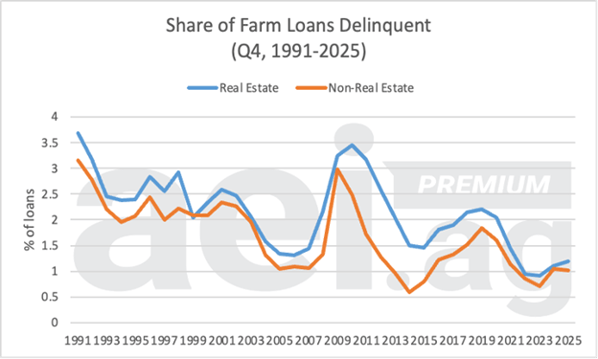 Figure 1. Share of farm loans delinquent, Q4 1991 – 2025. Data source: Kansas City Federal Reserve Bank.
Another consideration is the rate of annual change. Between 2024 and 2025, the share of delinquent farm real estate loans jumped by 0.1 percentage points (Figure 2). For context, the increase was 0.2 percentage points in 2024. The smaller increase is encouraging news. Previously, the annual change jumped 0.4 percentage points in 2016, 1.1 percentage points in 2009, and 0.7 percentage points in 2008. Notably, the overall delinquency rates were also higher at those times.
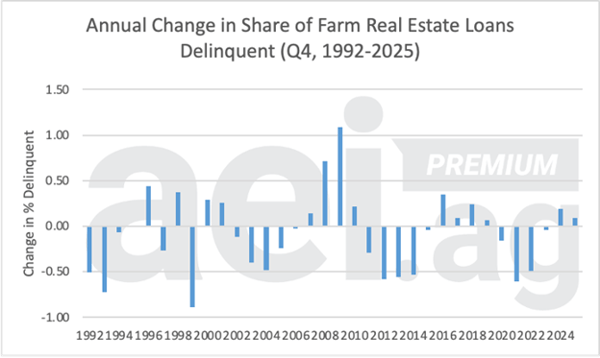 Figure 2. Annual change in the share of farm real estate loans that are delinquent, Q4 1992 to 2025.
Why delinquency rates provide better insights
While farm bankruptcy filings are frequently cited, those data may be less informative than they appear. First, bankruptcy is an extreme case of financial stress. Some farms may exit due to financial stress without filing for bankruptcy.
Second, farm bankruptcy (Chapter 12) has a debt limit of approximately $12.5 million in 2025. The implication is that not every farm filing for bankruptcy will qualify for Chapter 12. Furthermore, the upper limit jumped from $4.4 million to $10 million in 2019. That increase makes it hard to compare meaningful trends in the data over time.
In short, Chapter 12 bankruptcy data provides a very narrow, very severe measure of farm financial stress.
EDITOR’S TAKE:
Reported farm loan delinquency rates have increased since the 2023 low but remain well below the historical average. As recently as 2019, real estate delinquencies were considerably higher (2.2%) than they are today (1.2%).
So far, farm loan performance suggests that stress across the farm economy isn’t as severe as it was during the 2018-2020 slowdown. And while these data aren’t available back to the 1980s, current conditions are markedly improved compared with those throughout the 1990s.
This article suggests why your focus on the ag customers is justified. Your CAD membership comes with access to many tools and services that can help you serve those ag customers with pride and success. Be sure everyone on your team is well versed in all the programs and how to work them into the conversation. One tool that might help your team answer questions on the go is our special dealer CAD App – available on Apple or other app stores. It’s a great tool, check it out!