


A market specialist recently suggested that the ongoing war between Russia and Ukraine means the...
Temporary Grain Storage Could Be Fall 2026’s Pressure Valve
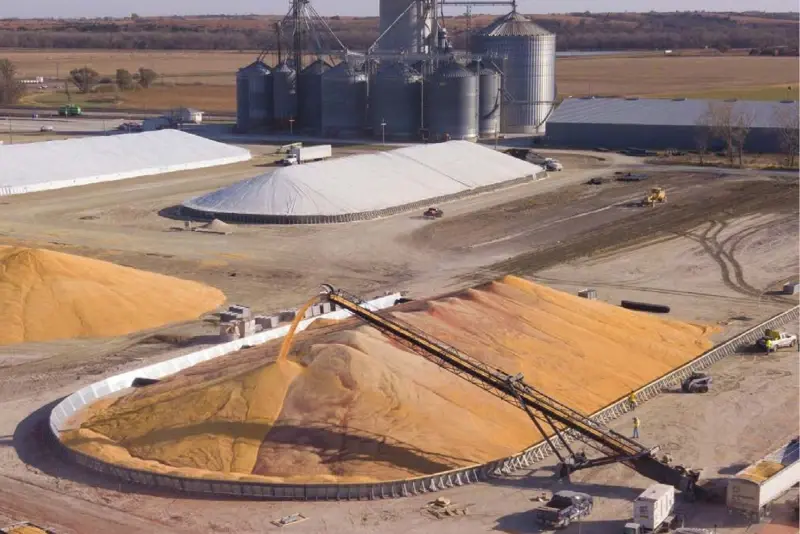
USDA reports on-farm corn stocks up 16% from a year ago, while storage capacity growth has plateaued. “Where are we going to put all the grain when harvest starts?” That’s the question John Tuttle with Brock (storage bin manufacturer) says more commercial grain handlers are asking as the 2026 harvest approaches. The pressure is building from several directions: high old-crop corn stocks, soft commodity prices, flat storage capacity growth and a narrowing construction window for permanent storage projects.
Total national corn inventory across all positions was 5.29 billion bushels, up 14% overall. At the same time, national grain storage capacity remains near 25.5 billion bushels, with about 13.6 billion bushels on farm and 11.9 billion bushels off farm. Overall construction and expansion of new storage capacity have largely plateaued since 2020.
Tuttle, who has spent nearly three decades with Brock, says those numbers raise a practical harvest-season concern.
“The numbers are really high. And so, when you begin to project forward, well, what will that mean for harvest? Are they going to move that grain, and are they going to have space for storage?” he says.
Local Pinch Points
The concern is not that the U.S. has no storage capacity. On paper, the national system is large. But harvest pressure is local. Space has to be available where grain is coming in, when combines are running and when producers need to keep trucks moving. If old-crop bushels remain in bins longer than usual, the system can tighten quickly.
“The commodity markets really didn’t rally such that I think everyone jumped on board, moved the grain,” he says. “Anyone sitting on ’25 crop from ’25 harvest year, it’s really a difficult position for them right now to pull the trigger and sell it.”
That could create what Tuttle calls “pinch points” as harvest approaches. “We’re not sure what they’re going to do,” he says. “We believe there’s going to be a pinch point there, and we expect to see some late demand, meaning over the summer to build some additional storage.”
Temporary Storage May Fix the Overflow
At the commercial level, Tuttle says interest in temporary storage is already active.
“We are seeing at the commercial level a lot of activity in our temporary storage products,” he says. “We saw activity in that last year, and I think we’ll continue to see that.”
Temporary storage is more often used by elevators and commercial handlers that need to add space quickly without building permanent bins before harvest. By mid-summer, large permanent commercial storage projects become more difficult to complete before fall harvest, as labor, concrete, site preparation, equipment and construction schedules compress the available window.
“When we get to this time of year on the calendar, large commercial storage projects become few and far between just because of the window of time,” Tuttle says. “We just don’t have the time to get all the work done.”
That is when temporary storage becomes Plan B.
“They’ll kind of switch their thinking and move to temporary storage and say, ‘hey, we need another million bushels, and we’re going to have to do it this way, because there’s no way we’ll get a permanent system built,’” he says.
The good news, according to Tuttle, is that time has not run out. Brock has inventory available, and basic temporary storage systems can move much faster than permanent construction.
“Monitoring market activity, we have adjusted inventory levels to meet potential demand. These systems are relatively quick and easy to install.”
The basic system is designed to contain grain with limited infrastructure. “I’m talking about a basic system,” Tuttle says. “This is where you just want to build walls to contain grain, and there’s not a lot of infrastructure involved.”
Brock also manufactures specialized high-capacity conveyors to fill temporary storage units; another part of the business Tuttle says is active.
“You can pull the trigger on something like that into August, and still have it for harvest or late harvest, if it’s needed,” he says.
Temporary storage may not be Plan A. But in fall 2026, it could be what keeps grain moving.
As Tuttle puts it: “It’s the Plan B, and that’s alright. We’ll work with Plan A, B, or C.”
EDITOR’S TAKE:
Driving across parts of the corn belt recently, I can see why farmers/ranchers might be concerned about a large crop and not enough storage. As the article points out, carryover stocks are higher than normal and now is not the best time to unload old crop corn. Temp storage has been used in the past to handle similar situations. It is a good answer if set up properly, especially with adequate air flow.
Farmers/ranchers will, however, be looking for other solutions that help them control their cost of production. Your answer, of course, is AgPack®. With the lease or purchase of a truck or SUV from a CAD member, they are eligible for up to nearly $50,000 in exclusive rebates and discounts for products they can use on the farm or ranch.