


Although China purchased a record amount of U.S. farm exports over the past two years, it wasn’t...
In recent weeks, “worst-case scenario” has been used to summarize the challenges in the Strait of Hormuz and the effects on U.S. fertilizer markets. With spring planting upon us, that argument made intuitive sense. However, we wondered about the seasonality of nitrogen imports and the extent of exposure.
Seasonality of the U.S. nitrogen imports
Figure 1 plots the monthly seasonality of U.S. nitrogen imports. Not surprisingly, activity generally kicks up during the spring. While March, April, and May are busy months for all three nitrogen sources, the uptick is very noticeable for urea. Specifically, the U.S. imports 44% of its urea between March and May.
For comparison, anhydrous ammonia and UAN imports during that three-month window are a combined 30%.
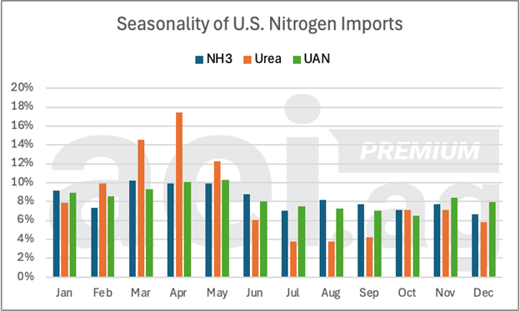 Figure 1. Seasonality of monthly U.S. nitrogen imports, average of 2020 to 2025. Data sources: U.S. Census Bureau and AEI.ag calculations.
How much is imported?
In addition to timing and seasonality, the share of supply that is reliant on imports is also important. Last April, the Liberation Day event also prompted concerns around fertilizer trade and prices. At that time, we stepped back to consider how much of the U.S. nitrogen supply was imported and found that roughly one-third of urea and UAN were imported (Figure 2).
Figure 2 also breaks out total imports (both shades of green) by the seasonality shown in Figure 1. Approximately 14% of the annual U.S. urea supply is imported during the March to May timeframe. That share is slightly less for UAN (10%) and considerably lower for anhydrous ammonia (3%). To be clear, these differences stem from the total share of supplies imported and the seasonality of import activity.
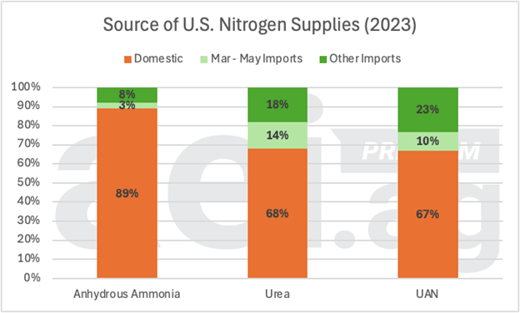 Figure 2. Source of U.S. nitrogen supplies, 2023. Data sources: USGS and AEI.ag calculations.
Wrapping it up
The big three nitrogen sources – anhydrous ammonia, urea, and UAN – account for 76% of U.S. nitrogen usage. The combination of 1) reliance on imports and 2) the seasonality of trade confirms that both urea and UAN products face considerable price risks in the months ahead.
While anhydrous ammonia has a small share of imports and is more insulated from the direct challenges unfolding in the Middle East, producers seeking lower-priced substitutes will likely shift the demand curve, raising prices for all nitrogen sources.
The immediate challenges are logistical, but the prospect of higher natural gas and transportation prices could affect all nitrogen fertilizers in the months and years ahead. So far, nitrogen prices have jumped the most, especially for anhydrous ammonia and liquid 32%. For a typical Corn Belt corn fertilizer application, the 2026 expense is $10 per acre higher than last month.
EDITOR’S TAKE:
The timing of a strike on Iran is unfortunate for the fertilizer industry and farmers/ranchers who depend on the product. High season demand, coupled with shorter supply/availability, has already led to higher prices. This is especially bad news for crop producers where margins are already razor thin. That provides you, as a CAD member, the perfect opportunity to promote AgPack®, which offers up to nearly $50,000 in exclusive rebates and discounts on items like fertilizer, tires, clothing, buildings, truck beds, irrigation equipment and much more.