An ecosystem scientist at Michigan State University says cropping system research is highlighting ways farmers can offset fertilizer use and other inputs.
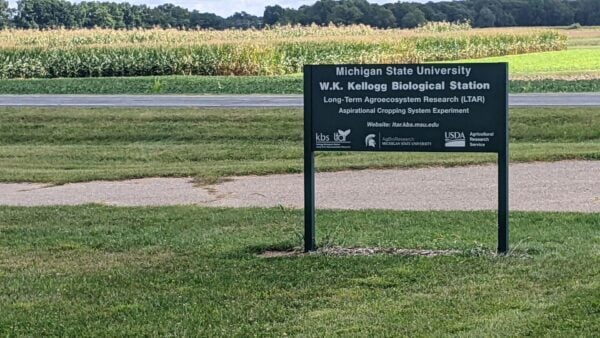
Phil Robertson is the director of the Long-Term Agroecosystem Project at the Kellogg Biological Station in Hickory Corners, Michigan.
“The nitrogen fertilizer, as an example, is one of the major costs in these systems, and when you increase the cost of one of your major inputs by 50 percent, you’re really eating into the potential profit,” he says. “In our aspirational corn system, we’re using about 1/3 of the fertilizer.”
He indicates compost and cover crops are reducing the need for synthetic fertilizer nitrogen and helping cut costs.
“And part of that is just increased efficiency due to the use of no-till and better attention to what the crop actually is pulling out of the soil in terms of nitrogen,” he shares.
Robertson says the profitability gap between conventional corn and soybeans and an aspirational system, which also includes wheat, forages, and canola, has been narrowing over the past five years.
“We’re very committed to our stakeholder-researcher partnership that we think is really going to push Michigan agriculture in directions that will be better for everyone, whether farmer or producer or consumer or environmental advocate,” he says.
Researchers recently published a new roadmap to guide future work focused on crop diversification; nutrient cycling and livestock integration; tillage management; precision inputs and conservation; soil health; and systems integration.
The project is part of a nationwide network of USDA-funded research sites working with stakeholders to improve farm profitability and long-term sustainability.
EDITOR’S TAKE:
I commend my Alma Mater for conducting this research. Cutting input costs, creating more efficient farms, and improving soil health to optimize sustainability are excellent objectives. The one gap remaining seems to be simultaneously maintaining or increasing profitability. Researchers report that the gap is narrowing over time and that is truly encouraging. I’m confident that with new techniques and technologies, they will eventually meet or exceed all their objectives. That will be good for agriculture, consumers and the environment.
Supporting your Land Grant University and the research they conduct related to agriculture will be noticed by your ag related customers. Farmers/ranchers will support those businesses who support them. Make sure you also make a point to let them know on social media that you are a CAD member who absolutely has their best interest at heart. It’s good for business!