
The holidays are a time of giving, and what could be better than giving the gift of agriculture?...
As Purdue economists continue exploring insights from the 2025 Large Commercial Producer (LCP) Survey, one subtle comparison stands out. Sometimes the smallest perception gaps reveal the biggest strategic questions.
This year, they asked large farmers to rank their top three sources of information for new production and management ideas. In a companion survey, agricultural retailers were asked the same question but from the perspective of what they believe their large farm customers consider most important.
The side-by-side results reveal an interesting tension.
Retailers think they are the primary source. Producers don't.
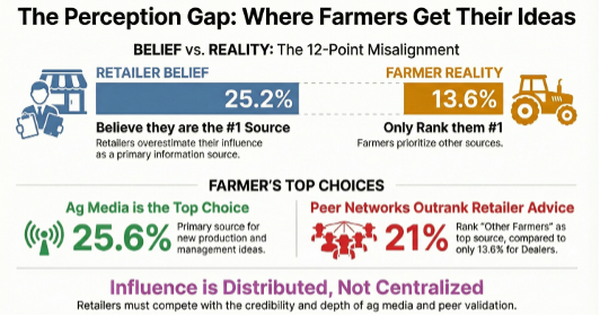
When asked to identify the single most important source of new ideas, 25.2% of retailers believed dealer or retailer representatives, publications, newsletters, advertisements, or websites were farmers' top sources. But only 13.6% of farmers actually ranked dealer or retailer sources first. That's nearly a 12-point perception gap.
Instead, producers ranked ag media first (25.6%), followed closely by other farmers (21.0%). Retailers also recognize the importance of peer networks, but they believe their own role is even stronger. This isn't a collapse of trust. Dealer and retailer sources still appear frequently in farmers' top three. But they are not the primary driver of new ideas in the way many retailers may assume.
A subtle but important tension.
The results suggest producers build ideas from a broader mix of sources than retailers expect.
For producers, ag media is the leading source of new ideas, while peer networks remain consistently influential across all three rankings. Universities, farm groups, dealers, manufacturers and field days all play meaningful roles depending on where producers are in the decision process.
Retailers, however, appear to anchor more heavily on relationship-based channels, particularly dealers and other farmers, when predicting farmer behavior. The question for retailers is whether they fully understand where producers are forming opinions before conversations with suppliers even begin.
Why this gap matters for agribusiness.
This isn't about who is right. It's about understanding how today's large farmers gather information.
If producers are increasingly discovering new ideas through ag media, peer networks and other distributed platforms before engaging in dealer conversations, then the retailer's role as an information provider may be evolving. That evolution extends well beyond the sales representative. It includes newsletters, websites, digital content, educational events, and every other touchpoint where producers encounter new ideas.
If retailers overestimate their position as the dominant information source, they may:
*Focus more on promotion than on differentiation within a competitive information environment.
*Underestimate how their digital content and communications compare with ag media in credibility, depth and usefulness.
Overlook the role peer networks play in validating, or challenging new ideas independently of supplier messaging.
*At the same time, farmers may underestimate the role retailers continue to play in implementation through local expertise, product access, financing and logistical support.
Both perspectives matter, but the flow of information appears more distributed than either side may assume.
Looking ahead.
The takeaway is not that retailers lack influence. It's that influence is increasingly shared across multiple channels. When farmers rank dealer or retailer sources lower than retailers expect, they are evaluating more than sales representatives. They are evaluating the retailer's entire information ecosystem; representatives, newsletters, publications, websites and promotional content.
That raises important strategic questions:
*Is our organization visible early in the farmer's information journey?
*Does our content compete with ag media in quality, relevance and credibility?
*Are we simply promoting products, or helping producers interpret ideas they are already encountering elsewhere?
Perception gaps rarely affect revenue overnight. But over time, they shape influence. In a multi-channel environment, the competitive advantage may not belong to the loudest voice. It may belong to the organization that best understands how farmers discover, evaluate and validate new ideas before making decisions.
EDITOR’S TAKE:
Although this study is focused primarily on the relationship between farmers and their ag retailer, it clearly has some relevance to CAD members as well. While CAD members may not be the source of new ideas for farmers, forming relationships with those who are such a source can be beneficial in gaining trust and access to farmers/ranchers. In addition, this study clearly delineates what types of media farmers/ranchers prefer. Are you using those sources? Here, just to reiterate where: It includes newsletters, websites, digital content, educational events, and every other touchpoint where producers encounter new ideas.
One example of such media is AgTruckTrader.com. It is a website that farmers/ranchers migrate to when seeking out their next truck purchase. It also provides you with a quality contact point as compared to those sites that merely upload a list and wait to see if anyone bites. AgTT is the place to be!