

|
|
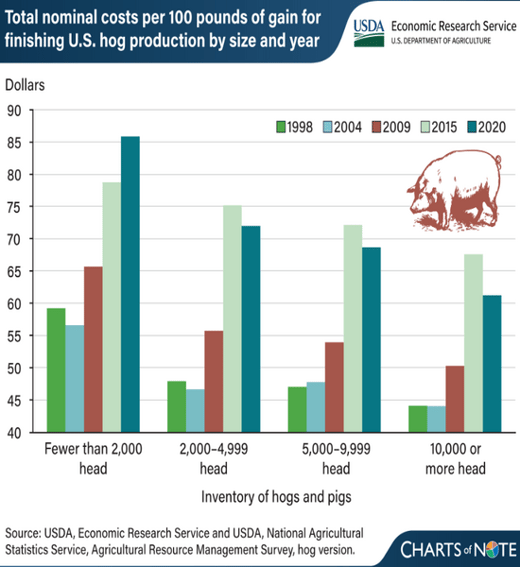
Over the past 30 years, U.S. hog production has consolidated into fewer, larger operations. This structural shift is consistent with the relationship between operation size and lower per unit costs.
Across five benchmark years of nationally representative surveys--1998, 2004, 2009, 2015, and 2020--total costs per 100 pounds of gain on hog finishing operations generally decreased as operation size increased. Although costs varied across years and on farms, larger operations tended to incur lower costs to add 100 pounds to a hog's weight than smaller operations.
Economies in ownership costs (buildings, equipment, and other capital investments) contribute to this relationship. Ownership costs can be distributed across more animals, thereby reducing their cost per unit of output. Unpaid labor costs were also generally lower on a per unit basis among larger operations.
More recent years reflect higher costs, but this trend is driven by rising input prices over time.
EDITOR’S TAKE:
Commercial hog production has been increasing in size of operation for at least the past 50 years. USDA has been tracking and reporting on this trend during that entire time frame. Let’s not forget the advances in genetics that have also been a part of increasing output at lower cost. More pigs per litter, faster gain and more lean versus fat, have all contributed to higher productivity and lower costs.
Hog and other livestock producers should be at or near the top of your ag customer prospect list. Also remember, they are more traditional in their communication preferences – print, radio and personal contact work well.


