

Record-high expenses and sharply lower federal subsidies will erode farm income in 2022, according...
This time of year, farmers are deciding whether their crops would benefit from a nutrient boost, weighing yield potential against the high cost of fertilizer.
A tool that monitors plant health from space is helping make those decisions easier.
Sentinel Ag collects images of crops via satellite and combines it with agronomic data to deliver recommendations to a farmer’s pocket. An email or app alerts users when a crop is showing signs of nitrogen deficiency or lack of moisture.
The program measures the bands of light that crops absorb or reflect through vegetative indexes, including NDVI and NDRE. They give a reading on how green and healthy the crop is. The big advantage, according to southeast Nebraska farmer Brian Brhel, is that the technology can spot plant health issues a week sooner than the symptoms are visible to the human eye. It helps farmers pinpoint what a plant needs and when.
A map from the Brhel farm shows the effects of nitrogen released over time from a terminated cover crop of hairy vetch.
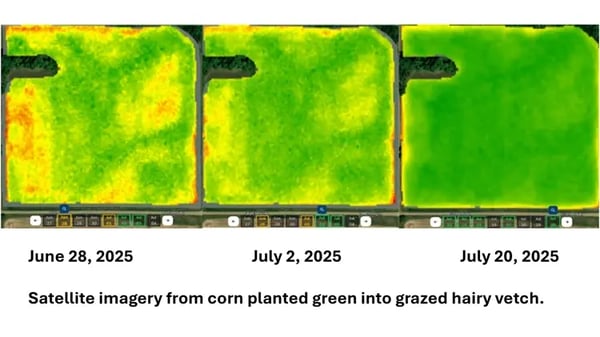
Submitted image
“Tissue samples tell the story of what has happened,” Brhel said. “This gives us the indication of what’s going to happen. I really am excited about the tool.”
Sentinel Ag is a Nebraska-grown company, created by a University of Nebraska-Lincoln graduate student with help from researchers there and support from groups including the Nebraska Corn Board. The full-scale service is now in its fifth season.
Brhel is one of 35 Nebraska farmers using Sentinel to monitor their fields in a project by the Nebraska Soil Health Coalition. Their goal is to learn what farmers can do to reduce nitrogen use and protect water resources that can become polluted when nitrogen is overapplied. Farmers are also learning what value they’re realizing from employing regenerative agriculture systems and soil health friendly practices like growing cover crops.
Last year, it helped confirm when cover crop residues broke down enough to release nitrogen that could be used by the growing corn. Brhel had grown a cover crop of hairy vetch and let his cattle graze it. He terminated the cover crop with chemicals when corn was planted in early May. About six weeks later, in early July, he could see the corn crop green up. Fellow farmers noticed similar timing in their fields, and readings from Sentinel confirmed their crop had adequate nitrogen.
“We learned the value of what our cover crops were providing even when we thought they wouldn’t produce enough nitrogen,” Brhel said.
Farmers in Sentinel Ag’s program saved an average 53 pounds of nitrogen across all farms last year. At $900 per ton for anhydrous, that accounts for a savings of $29 per acre. Using UAN 32% at $540 per ton, it’s a savings of $44.55 per acre.
“That is a substantial amount of nitrogen savings,” said Brhel, who is using Sentinel on his corn, rye and oats this year.
It saves farmers money on expensive inputs, and it helps keep nitrates out of the groundwater. Nitrogen applied before a plant can use it can move through the soil and wash away with the rain. Since it’s not always reliable to predict when it will rain, the tool can help farmers time their nitrogen application to when the plant needs it most.
Sentinel also monitors a plant’s moisture needs by satellite. It can help farmers decide when to turn on irrigation systems. In Brhel’s rainfed fields, he can see whether his cover crop is helpful in retaining soil moisture or if it’s using reserves.
He appreciates having good data that will help him make decisions, not for future crops, but for what’s growing in his fields now.
“This is something we can take action on this year,” he said. “I think it’s really economical.”
The Nebraska Soil Health Coalition plans to have a report after year two of the Sentinel project to share the value of using the tool – both economically for farmers and in terms of keeping nitrate out of the groundwater.
EDITOR’S TAKE:
This article does a very good job of laying out the advantages of satellite monitoring and use of data to improve timing of applications and reduce expensive fertilizer use. It is a testament to the innovative nature of farmers, but also their emphasis on sustainability. Sure, farmers are concerned about saving money, but they are equally concerned about their footprint on the environment. Just another example of how technology is playing such an important role in improving farming operations across the nation.
You can also help improve their operation by offering the AGwagon® truck option. The AGwagon is specifically designed by farmers/ranchers for farmers/ranchers. The combination of modern technology and practicality makes it a clear choice for those farmers/ranchers looking to have it all at their fingertips when and where they need it. If you don’t have one (or more) on your lot today, consider ordering one (or more) today!