

U.S. consumers will pay more for their favorite Independence Day cookout foods, including...
Artificial Intelligence Powering 4th Agricultural Revolution
-1.png)
Tech experts say generative AI will revolutionize farm operations from spreadsheet management to labor optimization.
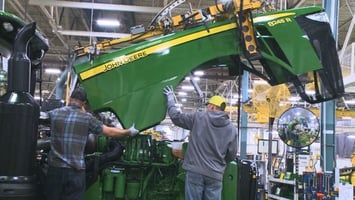
Known as the third Agricultural Revolution, American agriculture in the 1940s saw unprecedented technological advancements that significantly increased global food production. High-yield seed varieties pushed up productivity, while chemical fertilizers, pesticides and advanced irrigation technology fostered crops throughout the growth cycle. Concurrently, farm machinery got bigger, more sophisticated and incredibly powerful to cover rapidly expanding acreage.
Eight decades later, with the advent of drones, artificial intelligence and automation, farmers stand at the precipice of another historic era. “I think we’ve entered the fourth Agricultural Revolution,” declared William Aderholdt, co-founder and executive director of the Fargo, ND-based nonprofit Grand Farm. “We’ve moved from scaling and yield-chasing to optimization.”
Amid quickening technological advancement, he pondered: “It’s not just about technology; what does it mean for our society? How can we enable the future?” Adoption, he argued, is just as important as development.
Behind the physical technology that’s fundamentally changing in-field operations, theoretical questions like those posed by Aderholdt in academic forums are molding tomorrow’s agricultural norms. Inventions being conceptualized in classrooms right now will one day roll across turnrows. Within this evolution, it’s becoming clear that some innovations hold more potential than others.
“I believe that AI and some of the more recent advances of generative AI will change the practice of farming,” said Vikram Adve, director of the University of Illinois-centered Artificial Intelligence for Future Agricultural Resilience, Management, and Sustainability Institute. At its core, AI is coded math. In simple terms, queries are routed through complex “if this, then that” equations to create simplified answers. Generative AI creates new, original content by finding trends in massive datasets.
Streamlining operations
While the challenges that tomorrow’s farmers face will not change, like soil biology and the impact of weather, “the way that decisions are made will be profoundly impacted by generative AI,” Adve said.
Beyond agronomy chatbots that are emerging on the marketplace, he predicts generative AI will take over tedious farm shop tasks like managing spreadsheets, making sense of collected sensor data, scheduling, minimizing fuel usage, optimizing labor costs and sorting supplier information.
This all sounds helpful for future farmers. But as today’s producers across the country prepare for another planting sprint into an uneven ag economy, theoretical discussions hosted by suit-wearing professors in the nation’s capital might not seem immediately relevant.
Here’s where the rubber meets the turnrows: “If AI is changing so fast, where do you place your bets? The best way to get started is to start soon,” Adve said.” Large language models are evolving,” but the technical framework that’s built on top of those foundations will remain unchanged.
The same advice can be applied to its in-field adoption. Technology builds on itself. Autonomous tractors require highly accurate GPS systems and telematic data collection. A farmer installing today’s technology to increase next season’s profit is simultaneously preparing for whatever comes next.
Jaye Hamby, director of USDA’s National Institute of Food and Agriculture, contextualized the session’s topic with in-field experience: “There’s transition happening from precision ag to decision ag. AI has brought us to the dawn of that reality. You call it yield chasing. I call it more bushels in the bin. In short, cutting-edge technology like AI stands to increase profitability by doing more with less, and farmers should take notice.”
EDITOR’S TAKE:
If you are like many Americans, AI is still a mystery and most people are skeptical. I, for one, have more questions about AI than answers at the moment. That said, if people much more informed than me, like my good friend Jaye Hamby, have looked into the crystal ball and determined that it will be a positive, then I will accept their wisdom. It is easy to see the opportunity for farmers/ranchers to more quickly gather and analyze data from many sources around the farm/ranch to accommodate faster and more informed decision making. The rapid integration and analysis of data will help provide a pathway to greater margins and profitability. This would mark a huge step forward in the history of agriculture!
You too can make a big step forward in agriculture truck sales by utilizing all the tools CAD provides. I’m talking about AgPack®, AgTruckTrader.com®, AGwagon®, CADFI, CAD Protect, our latest dealer market analysis tool, relationships with organizations like PRCA, AQHA, RMEA and our amazing CAD Pro Rodeo Team. The program will only help you succeed if you use it. Any questions, please give us a call….